

SEO Services SEO Competitor Analysis
Compare the market without copying it
SEO Competitor Analysis Service Bangladesh
Our SEO competitor analysis service in Bangladesh compares the search competitors that matter—not just the businesses you already know. We examine keyword overlap, content coverage, visible strengths and backlink gaps, then turn the useful differences into a prioritized action list for your own site.
Quick answer
Competitor analysis should tell you where the market is stronger than your site—and which gaps are worth closing.
A competitor SEO audit is not a request to copy another website. It is a structured comparison. We look for differences in search coverage, page types, topic depth, authority signals and visible performance patterns, then separate useful opportunities from things that do not fit your business.
Find real search competitors for the topics and services that matter.
Show why a gap matters instead of delivering a spreadsheet with no decision attached.
Turn the findings into a short action register rather than copying every competitor tactic.
Who should be in a competitor SEO audit?
The useful set normally mixes direct business competitors with domains that repeatedly win the search results you care about. That prevents the analysis from becoming a comparison against famous brands that operate in a different market or serve a different buyer.
Companies competing for the same customer, service area, product or contract.
Useful for commercial positioningDomains that appear for the same commercial and informational queries even when their business model differs.
Useful for search visibility gapsNearby businesses that matter when Maps, service areas or city-level intent affects the buying journey.
Useful for local demandPublishers or specialist sites that win research-stage searches your prospects use before they are ready to enquire.
Useful for topic coverageThe gap matrix
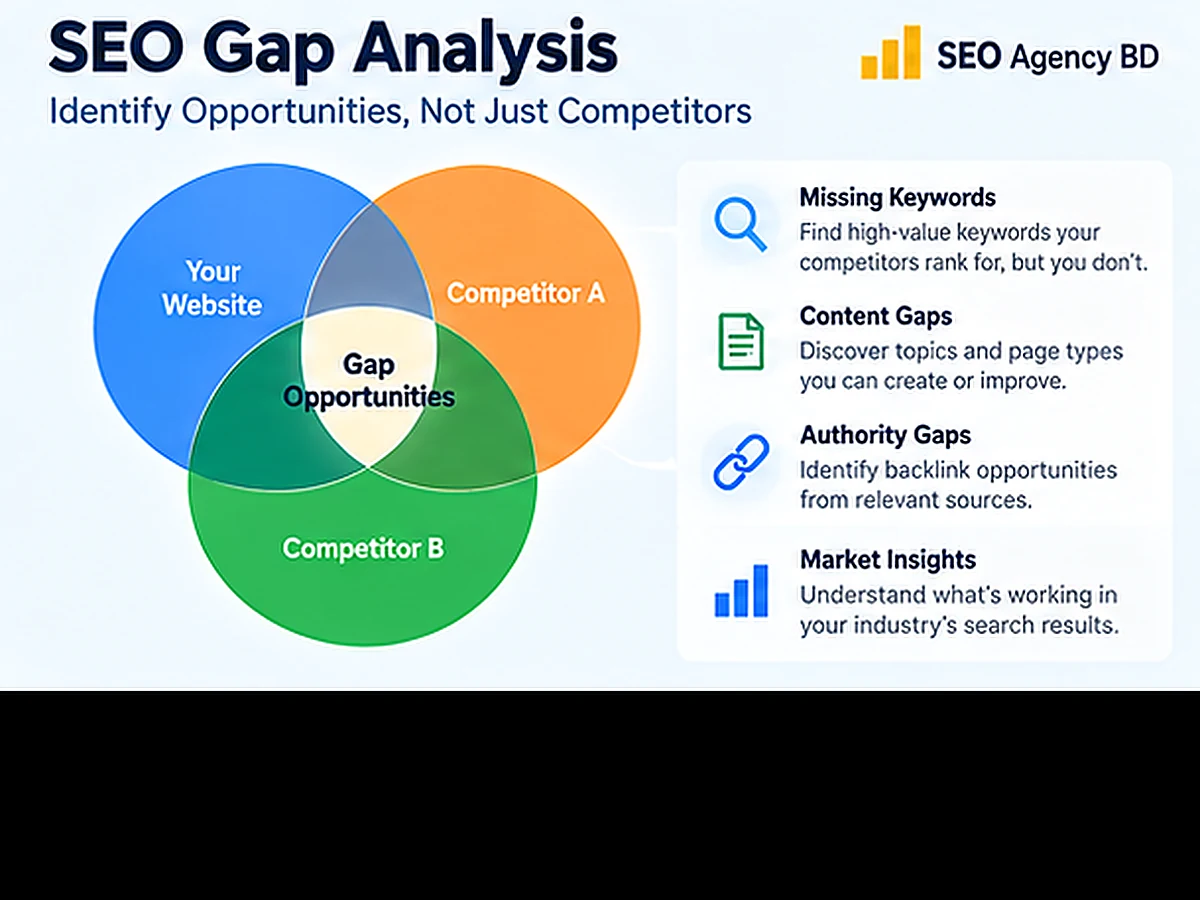
Four comparisons reveal very different SEO decisions
A gap only becomes useful when it leads to a decision. We keep keyword, content, technical visibility and backlink findings separate long enough to understand what each one actually means.
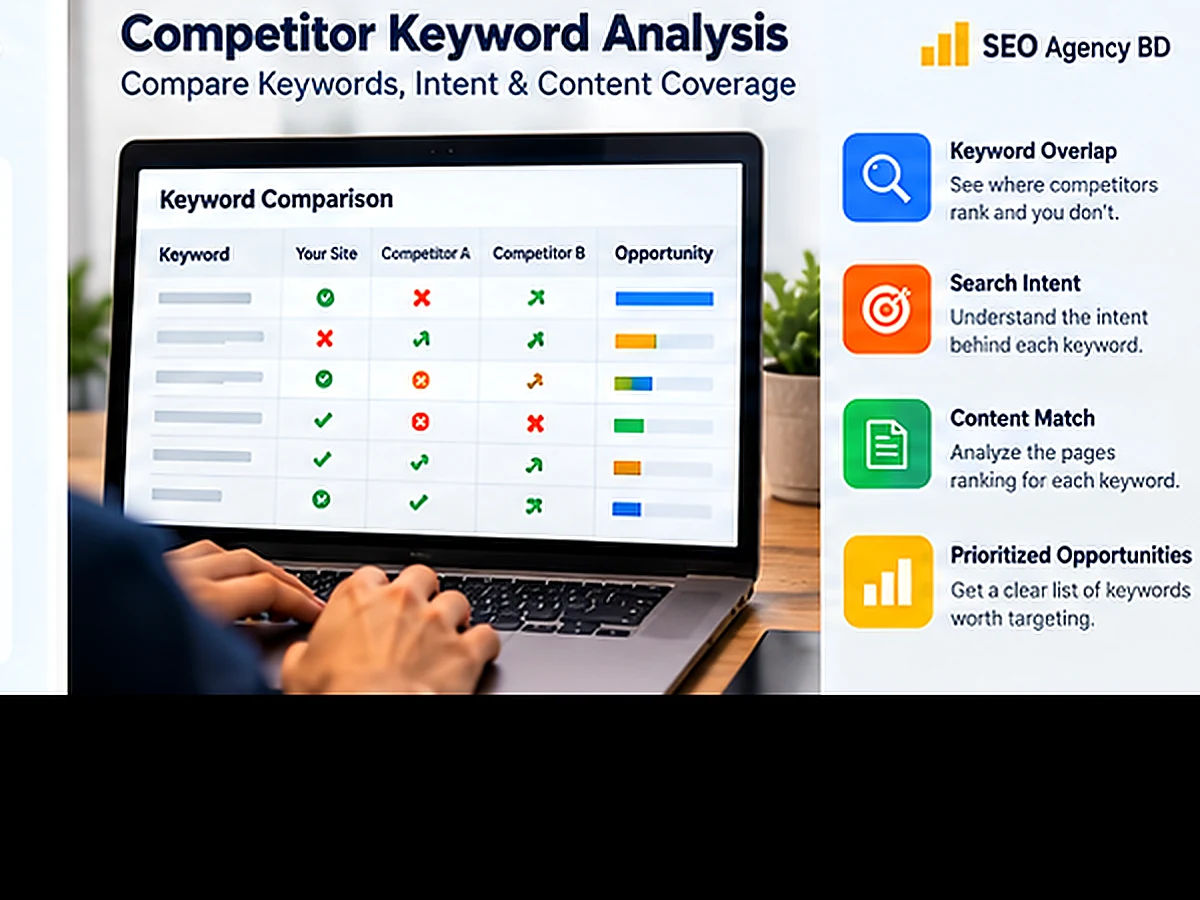
Keyword overlap and missing demand
Compare the queries and intent areas competitors appear for, then identify where your site has no suitable page, weak coverage or the wrong page competing.
Content and page-type gaps
Compare which service, category, guide, location or supporting pages help competitors cover the customer journey. The aim is to find missing usefulness, not match their page count.
Visibility and structural differences
Look for patterns in which sections and page types earn search visibility. When a gap appears to be structural or technical, the competitor finding becomes a diagnosis input rather than a copy instruction.
Backlink and authority gaps
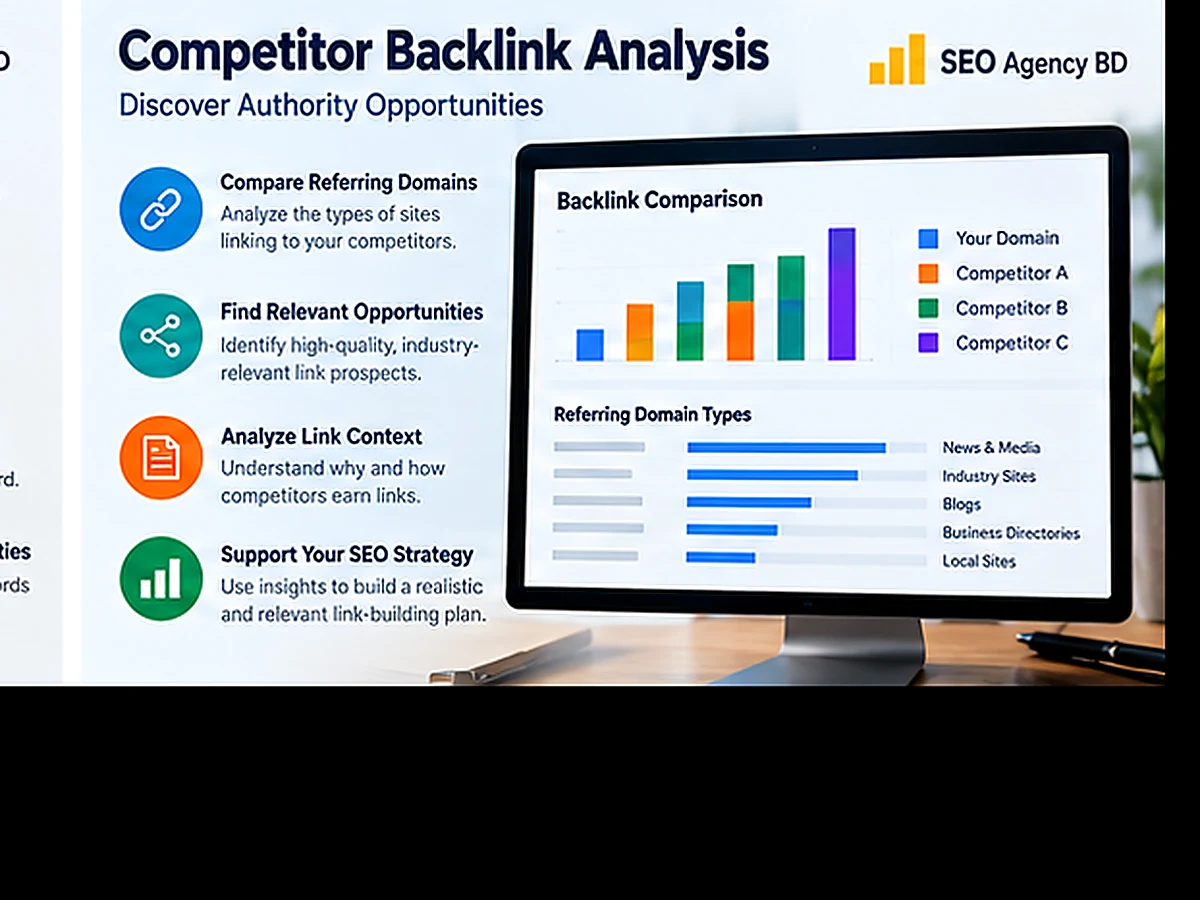
Compare the types of relevant sites that reference stronger competitors. We care about context and repeatable opportunity patterns, not just a larger link total.
Clear service ownership
Competitor research informs other services without replacing them
This page owns competitor-analysis intent. The related pages below take over when the main job becomes broader discovery, planning or implementation.
Keyword Research Services owns broad keyword discovery, clustering, intent and page mapping. This page only compares keyword gaps against competitors.
If the main need is turning many findings into a phased organic-growth plan, use SEO Strategy Services.
When the finding is mainly missing topic clusters and editorial sequencing, move to SEO Content Strategy.
The comparison can identify backlink patterns, but hands-on acquisition belongs to Link Building Services.
If the problem extends beyond competitor gaps into broad technical and content diagnosis, start with a Complete SEO Audit.
How the analysis is built
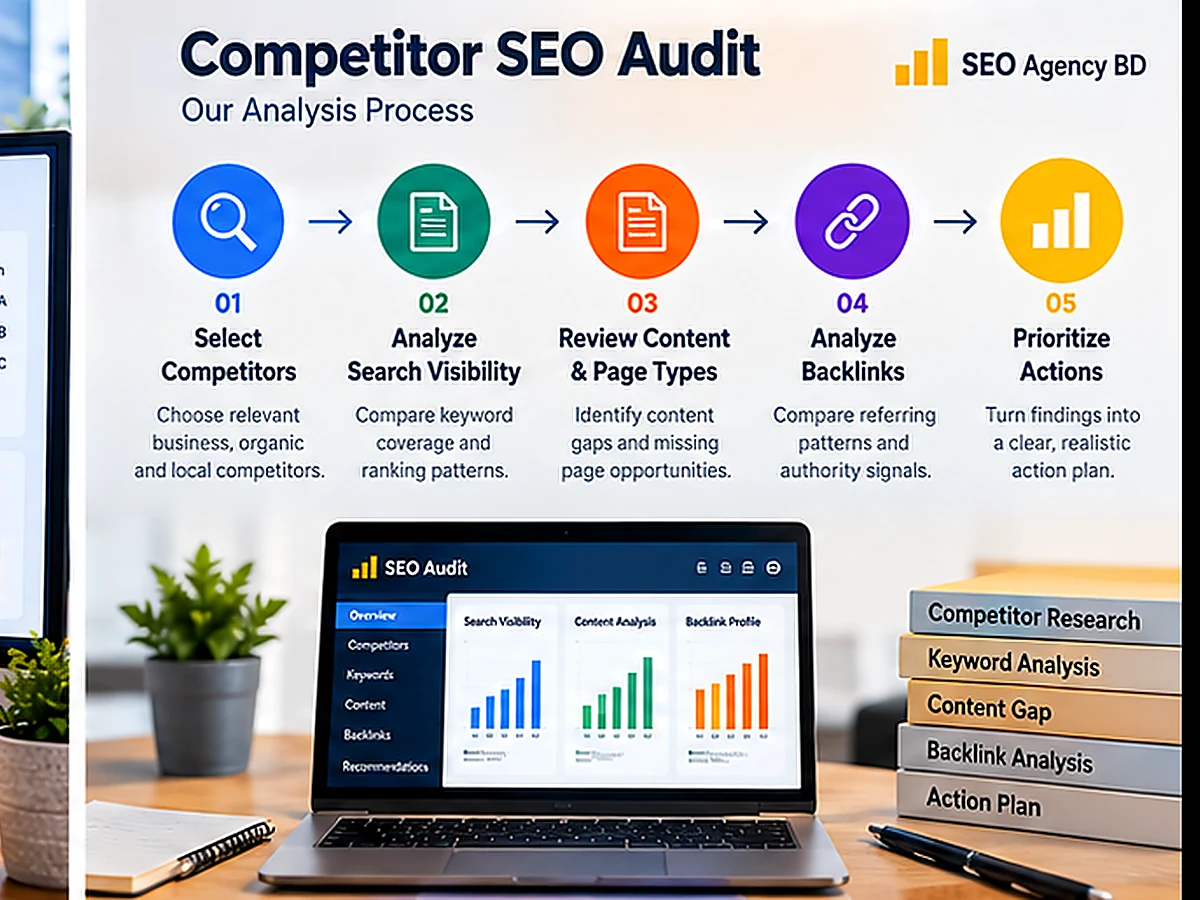
Competitors → evidence → gaps → validation → actions
We keep the workflow narrow and auditable. The deliverable should show where a finding came from and what decision it supports.
Choose direct, organic and—where relevant—local competitors tied to the search areas that matter.
Review search coverage, page types, content patterns and external authority signals across the agreed set.
Remove differences that do not match your services, market, location or customer journey.
Check whether the apparent gap is truly missing or whether an existing page simply needs stronger structure, relevance or internal support.
Turn the surviving gaps into a short action register with recommended owner and next service where needed.
What the deliverable should answer
An action register is more useful than a competitor screenshot deck
The exact format depends on scope, but each major finding should connect evidence to a practical decision. That makes the analysis easier to hand to an SEO strategist, content team, developer or link-building specialist.
| Finding type | Question answered | Typical evidence | Recommended next owner |
|---|---|---|---|
| Keyword gap | Which relevant searches do competitors cover better? | Query groups, intent, competing URLs and page overlap. | Keyword / on-page SEO |
| Content gap | Which useful page or topic is missing or weak? | Page types, topic depth, internal relationships and customer-journey coverage. | Content strategy |
| Structural gap | Is visibility limited by site organization or technical constraints? | Architecture, indexability, internal paths and visible page patterns. | Technical / on-page SEO |
| Backlink gap | What kinds of relevant third-party references support competitors? | Referring-source themes, link context and repeatable opportunity categories. | Link building / off-page |
| Priority gap | Which difference is worth acting on first? | Business fit, search intent, effort, dependencies and expected usefulness. | SEO strategy |
How we interpret the evidence
Competitor metrics are clues, not business goals
A competitor can have more ranking pages, more links or more content and still be a poor model for your business. The analysis is useful only when the numbers are interpreted alongside intent, page quality, relevance and your own commercial priorities.
Use competitor overlap to expose missed or weak search areas, then validate whether the demand actually belongs in your keyword map.
Compare purpose and coverage rather than copying headings, word counts or a competitor's publishing volume.
Look for relevant source patterns and relationships. A raw backlink count is not treated as a target by itself.
Use your existing search and conversion data where available to decide whether a competitor gap supports a real business opportunity.
Every high-priority recommendation should state the observed gap, why it matters and which team or specialist scope should handle it.
SEO Agency BD can use competitor analysis as a focused service or as an input to a wider plan. The source brief does not provide client-specific case-study numbers for this page, so no traffic gains, link totals or ranking improvements are invented here.
Good timing matters
When competitor analysis is the right next step
It is most useful when the site already has a clear business goal but the team needs evidence about where competitors are winning search demand or authority.
You know the market and offer, but need to see which keyword, content or backlink gaps deserve attention.
You are planning a new SEO roadmap and want competitor evidence before deciding what to prioritize.
You do not yet know your own search demand, intent groups or page map. General discovery should come before competitor-gap comparison.
The site has serious crawl, indexation or content problems and the immediate issue is diagnosis rather than market comparison.
Before you request the analysis
Common competitor SEO questions
This service is designed to answer a narrow commercial question: where do relevant search competitors have an advantage that is useful for your business to understand?
What is included in an SEO competitor analysis?
The scope can compare relevant competitors across keyword overlap, content and page coverage, search visibility patterns and backlink opportunities. The deliverable then prioritizes the gaps that fit your business rather than treating every difference as a task.
How is competitor keyword analysis different from keyword research?
Competitor keyword analysis starts with other sites and asks where their search coverage differs from yours. General keyword research discovers, clusters and maps demand whether or not a competitor already ranks for it. The dedicated Keyword Research page owns that broader discovery intent.
Do you copy competitor content or backlinks?
No. The point is to identify patterns and gaps, then decide what is relevant to your business. Content should remain original, and backlink opportunities still need their own relevance and quality checks.
Can you analyze local competitors in Bangladesh?
Yes, when local search is part of the business goal. The competitor set can include businesses that matter in the same city or service area, but the analysis still focuses on the search topics and customer journey relevant to the project.
How many competitors should be analyzed?
There is no useful fixed number for every project. The set should be large enough to expose repeatable patterns without filling the report with unrelated domains. Scope is agreed around the market, keyword set and business goal.
Does competitor analysis guarantee better rankings?
No. It can improve decision-making by revealing gaps and patterns, but rankings still depend on your site's implementation, relevance, competition and many other factors. We do not guarantee ranking outcomes.
Find the gaps worth acting on
Compare your search market before adding more SEO tasks
Share the website, the services or products that matter, and any competitors you already know. We can scope a focused comparison around keyword, content and backlink gaps, then show which findings deserve a next step.