
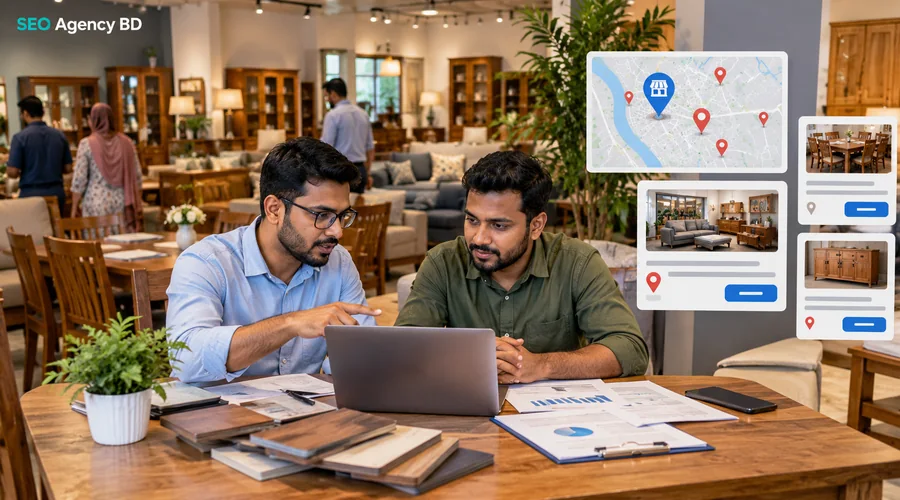
Case study scope: what the furniture shop needed local SEO to do
A Dhaka furniture showroom has a mixed search journey. Some buyers search for a broad store such as “furniture shop in Dhaka.” Others are much more specific: sofa, bed, dining set, office chair, custom furniture, a nearby showroom, directions, opening hours, delivery or a product category in a particular part of the city.
That means the job is not simply “rank the homepage.” The local-search system has to connect three things: the physical business, the products people want, and the website pages that explain those products clearly. Current Dhaka furniture search results also tend to mix showroom pages, product/category pages, directories and location-led results, so the store needs both local entity signals and useful website content.
Evidence boundary: the sitemap says this existing post should add methodology, baseline, timeline and measurable outcomes where available. The supplied source set does not include the original client identity, baseline metrics or verified result figures. We therefore publish the process and measurement framework without manufacturing a percentage, ranking position, review count or revenue claim.
Baseline audit: what we check before changing the profile or website
A local SEO case study in Bangladesh is only useful when the starting point is clear. Before implementation, we would record the business information and the search data that can later be compared against the same sources.
| Baseline area | What we verify | Why it matters |
|---|---|---|
| Business Profile | Verification status, name, address, phone, hours, category, website, description and service details | Incomplete or inaccurate information can weaken relevance and customer trust |
| Local visibility | Non-brand discovery queries, map/local-pack visibility by location, calls, directions and website actions | A single rank checked from one device does not represent a whole city |
| Website | Store/location page, product categories, titles, headings, internal links, mobile usability and indexation | Google uses website information as one source for understanding local businesses |
| Reviews | Review recency, response workflow and whether requests are made ethically | Reviews help customers decide and can contribute to local prominence |
| Photos | Exterior, interior, furniture categories, real showroom activity and image quality | Furniture is visual; useful photos reduce uncertainty before a visit |
| Citations | Name, address and phone consistency across important local listings | Conflicting location data makes the entity harder to understand |
Methodology: how we would improve a Dhaka furniture store step by step
1. Match the Business Profile to the real showroom
The first job is accuracy, not keyword stuffing. The business name should reflect the real-world name. The address should match the customer-facing showroom. Opening hours, phone number, website link and categories should be correct. Product and service details should describe what the shop actually sells.
Google’s current local ranking guidance says local results are mainly based on relevance, distance and prominence. A complete profile helps Google understand relevance, but there is no setting that can remove the distance factor or guarantee a better position.
2. Separate brand, product and location intent
A furniture buyer searching for a sofa is not asking the same question as someone searching for the store name or for directions. We map those intents to the right destination: the Business Profile for immediate local discovery, a strong showroom/location page for visit information, and useful category pages for beds, sofas, dining furniture, office furniture or other real stock groups.
This prevents a common problem: one thin page trying to rank for every furniture product and every Dhaka area. A page should exist because it helps a customer, not because a neighborhood name can be inserted into a heading.
3. Make the website support local relevance
The store page should make the physical business easy to understand. Useful details can include the correct address, hours, contact options, directions, main product categories, delivery or pickup information, showroom photos and a short explanation of what customers can expect when they visit.
From there, internal links should connect local visitors to the right products or buying guides. For commercial industry-level SEO, the dedicated Furniture SEO page remains the correct owner. For broad agency searches in the city, the SEO Agency in Dhaka page owns that intent. This case study stays focused on evidence, method and results reporting.
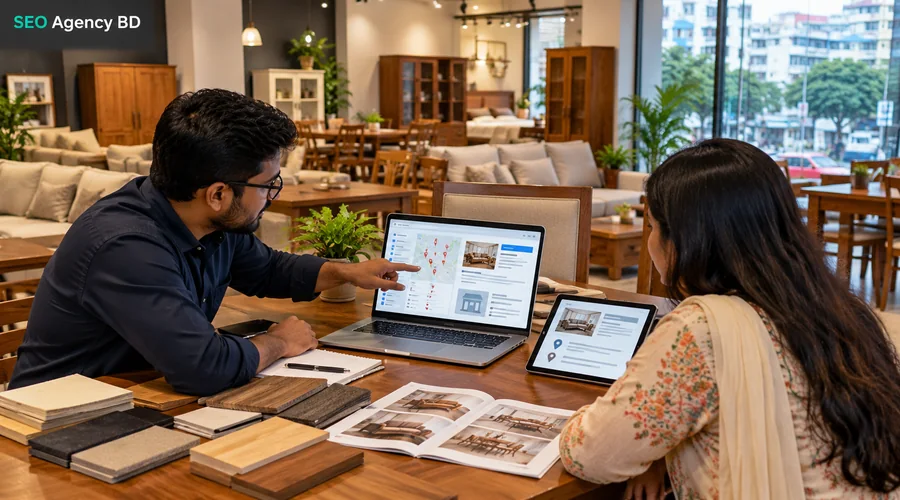
Google Maps and Business Profile work for a furniture showroom
A furniture store Google Maps case study should show practical work, not a screenshot with a lucky ranking. For this type of business, the profile needs enough detail for a buyer to decide whether the showroom is relevant before they travel across Dhaka.
Choose categories that match the actual business model. Do not add unrelated categories just to appear for more searches.
Add clear real photos of the exterior, entrance, showroom, major furniture ranges and customer-facing areas. Google recommends profile photos that are in focus and well lit.
Ask genuine customers for honest reviews and reply professionally. Google prohibits paying, discounting or giving goods or services in exchange for reviews.
Keep hours, contact details and major business information current. Stale details create friction even when the profile ranks.
When deeper profile work is required, the relevant specialist pages are Google Business Profile Optimization and Google Maps SEO. The broader parent service remains Local SEO Services.
Website changes that matter for a Dhaka furniture shop
Local SEO is not separate from the website. Google says it may source Business Profile information from publicly available web content, so the website should reinforce the same business identity and make the local landing experience useful.
Build pages around real furniture categories
If the shop genuinely sells sofas, beds, wardrobes, dining sets and office furniture, each important category can have a useful page with product types, materials, dimensions, care information, delivery notes and clear routes to enquire. Thin keyword pages such as “best sofa shop Dhaka,” “top sofa store Dhaka” and “sofa showroom Dhaka” do not need separate URLs when they serve the same intent.
Show local proof without inventing it
Real showroom photos, delivery areas, verified project photos, customer questions, warranty information and accurate business details are more useful than generic claims. If a testimonial, review count, sales figure or client result cannot be verified, leave it out.
Make the next action easy on mobile
A local visitor may want to call, open directions, send a WhatsApp message or check a category quickly. Those actions should be clear without covering the page with repeated buttons. The page also needs readable text, fast images and no horizontal scrolling.
Citations, reviews and local trust signals
Local citations are useful when they make the business data more consistent and easier to verify. They are not a reason to submit the store to hundreds of low-quality directories. Start with relevant, trusted sources and keep the name, address and phone consistent.
For specialist implementation, the sitemap assigns citation intent to Local Citation Building and review/reputation workflow to Online Review Management. Keeping those intents separate helps avoid cannibalization while still giving this case study enough context.
Implementation timeline: how the work should be staged
The source material does not provide a verified historical timeline for the original furniture shop. The timeline below is therefore an implementation framework, not a claim that a client achieved a result in a fixed number of days.
| Stage | Main work | Evidence captured |
|---|---|---|
| Week 0 | Baseline audit, query map, Business Profile review, website crawl, NAP check | Screenshots/exports, Search Console baseline, Business Profile performance, conversion tracking status |
| Weeks 1–2 | Fix profile data, categories, hours, landing page, contact details and technical blockers | Change log and implementation dates |
| Weeks 3–6 | Improve category/location content, photos, internal links, citations and review-request workflow | New pages/assets, citation records and review-request process |
| Weeks 7–12+ | Compare visibility and actions, refine weak pages, continue real photo/review activity | Like-for-like reporting from the same tools and locations |
Furniture local SEO results in Dhaka: what can be reported honestly
The most important QA decision on this page is not to fabricate an outcome. No verified baseline or post-campaign numbers were supplied for the original furniture shop. That means we cannot responsibly publish “3× calls,” “top 3 rankings,” a review-growth percentage, traffic growth or revenue uplift.
Instead, a defensible result section should be filled from the original reporting sources. The same rule should apply to any Dhaka business SEO case study.
| Result metric | Best evidence source | Status for this source package |
|---|---|---|
| Non-brand organic clicks and impressions | Google Search Console | Verified values not supplied |
| Local/map visibility across Dhaka | Consistent geo-grid or local rank tracking methodology | Verified values not supplied |
| Business Profile calls, directions and website actions | Google Business Profile performance data | Verified values not supplied |
| Organic enquiries | Analytics plus CRM, call or WhatsApp lead records | Verified values not supplied |
| Review growth and response rate | Business Profile review history | Verified values not supplied |
Furniture-specific local SEO lessons from the methodology
Product intent and place intent overlap
Furniture searches often combine what the customer wants with where they want to buy it. That makes strong category pages and accurate local business information more valuable together than either one alone.
Showroom photos are part of the buying decision
A sofa, dining table or wardrobe is difficult to judge from a business name alone. Real, well-lit images can show range, scale, style and the physical shop before a customer travels. This is especially important for a high-consideration purchase.
Do not turn Dhaka into dozens of doorway pages
If a shop has one real showroom, that does not justify near-identical pages for every neighborhood. A location page should represent a real branch, service area or genuinely different local experience. Broad Dhaka SEO intent belongs to the dedicated city page, not this case study.
Measure actions that sales staff recognize
Impressions are useful, but the team should also know whether organic/local search is producing calls, direction requests, WhatsApp conversations, store visits or product enquiries. That is how the SEO report becomes useful to the business owner.
Case-study checklist before publishing any local SEO result
- Record the baseline before implementation.
- Keep the client anonymous unless permission to name the business is confirmed.
- Use the same tools and measurement method for before-and-after comparisons.
- Do not present one-location ranking screenshots as citywide visibility.
- Separate work completed from outcomes observed.
- Do not attribute revenue to SEO without a clear tracking method.
- Do not buy, gate or incentivize Google reviews.
- Use real showroom and product photos rather than generic stock proof.
- Link the case study to the relevant service page without turning the article into a sales page.
Frequently asked questions
What should a furniture shop track for local SEO in Dhaka?
Track non-brand search visibility, Search Console clicks, Business Profile calls and direction requests, website actions, relevant product/category landing pages and qualified enquiries. Use the same measurement method over time.
Does Google Maps ranking depend only on reviews?
No. Google says local results are mainly based on relevance, distance and prominence. Reviews can contribute to prominence and customer trust, but they do not override distance or guarantee a local-pack position.
Should a furniture store create a page for every Dhaka area?
No. Create a local page when it represents a real showroom, branch, service area or genuinely unique local information. Near-duplicate neighborhood pages can create poor user experience and keyword overlap.
Can a furniture store ask customers for Google reviews?
Yes. Google allows businesses to ask genuine customers for reviews, but it prohibits incentives such as discounts, free goods or payment in exchange for a review or a change to a review.
Why are there no percentage results in this case study?
The supplied source package does not contain verified before-and-after metrics for the original furniture business. Publishing invented numbers would make the case study less trustworthy, so this version shows the method and the exact evidence needed before numeric results are added.
Sources and implementation references
Need local SEO for a furniture showroom or Dhaka business?
If you want the commercial service rather than the case-study method, review our Furniture SEO and Dhaka SEO pages. We can also audit your Business Profile, local landing pages, citations and measurement setup before recommending changes.