

Travel Agency SEO in Bangladesh
Travelers do not search for one thing. They compare destinations, packages, air tickets, hotel options, dates, local agencies and the details that make a trip feel safe to book. We build travel SEO around that journey so useful pages can be found before the customer has chosen an agency.
A booking can start with a country name, a budget, a date, a ticket or a question.
That is why tour operator SEO in Bangladesh should not be built around one “tour packages” page. The site has to catch different levels of intent and then move the traveler toward a useful package, consultation or booking enquiry.
- 01Explore a destination
Country, city and seasonal destination pages answer broad planning questions and guide the visitor to relevant packages.
- 02Compare a package
Dates, duration, route, hotel level, inclusions, exclusions and realistic next steps matter more than repeated sales copy.
- 03Check logistics
Air-ticket, hotel, transfer or visa-support information can support the trip without turning every service into a competing page cluster.

- 04Verify the agency
Real business details, current affiliations where applicable, office information, policies and a clear contact path reduce uncertainty.
- 05Ask a practical question
Travelers often need help with timing, route, refund/change conditions, package availability or what is included before they are ready to buy.
- 06Contact or book
Phone, WhatsApp, enquiry and booking actions should be easy on mobile without covering the package information the visitor came to read.
The site should move from destination to package to booking without creating hundreds of near-duplicate URLs.
Travel SEO services in Bangladesh work best when each page has a clear job. We use keyword research and intent mapping to decide which searches deserve destination hubs, which belong on package pages and which should remain informational.
A package page has a life cycle. The URL strategy should survive longer than one departure date.
Tour package SEO in Bangladesh often fails when every departure creates a new thin URL or old packages stay indexed with no useful next step. The better approach depends on whether the trip repeats, changes materially or is gone for good.
Google recommends long-term, persistent URLs and warns against unnecessary short-lived URL variations. When a page is permanently gone, a real replacement can receive a 301; if there is no replacement, a 404 or 410 is appropriate. Google Search Central URL guidance.
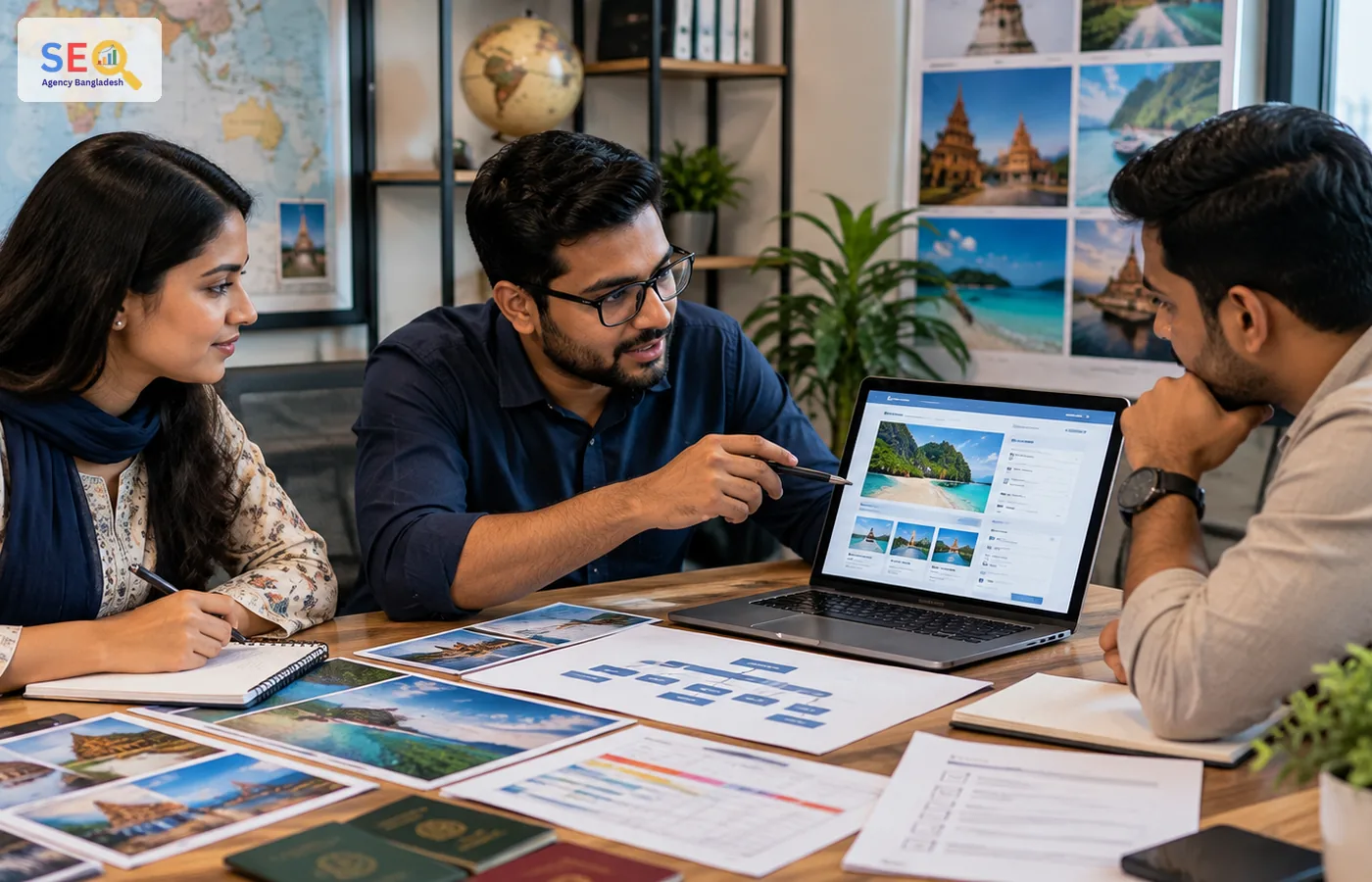
We audit the search journey before adding more destinations or blog posts.
Travel sites can look busy while still hiding the pages that matter. The first job is to identify the real bottleneck—indexing, package architecture, weak destination coverage, poor local signals, slow WordPress templates or a conversion path that loses mobile visitors.
- Audit crawl, index and conversion paths.
Review Search Console, important landing pages, duplicate URLs, package templates, local visibility and enquiry actions. A deeper baseline can start with a complete SEO audit.
- Map destinations, packages and services.
Give each commercial search need one primary page owner so package pages support rather than cannibalize destination hubs.
- Fix on-page and technical blockers.
Improve titles, headings, internal links, canonicals, crawl paths and template behavior through on-page SEO and technical SEO.
- Upgrade package and destination content.
Replace repeated brochure copy with useful route, timing, inclusion, exclusion, availability and traveler-decision information. When writing support is needed, use a controlled SEO content workflow.
- Strengthen local discovery and trust.
Align the real office or storefront, contact details, Business Profile eligibility and website location signals without creating fake branches.
- Measure enquiries, not just positions.
Track which destinations and packages generate qualified calls, WhatsApp actions, booking enquiries and repeat search visibility.

The local listing should describe the business that actually exists.
A staffed storefront can be useful for travelers who want an in-person consultation. An online-only travel site is different. Google says online-only businesses and lead-generation businesses are not eligible for Business Profiles, and virtual offices are not a substitute for a real customer-facing location.
Source: Google Business Profile eligibility and business representation guidelines.
- Use the real business name. Do not add destination, “best travel agency” or city keywords unless they are genuinely part of the registered/customer-facing name.
- Represent real offices only. A serviced desk, mailbox or unstaffed virtual address should not be turned into a local SEO location.
- Keep office details consistent. Address, phone, hours and website landing page should agree across the profile and site.
- Use service areas only when they describe a real service model. Selling trips to customers from many cities does not automatically make a travel agency a service-area business.
- Show verifiable trust information on the website. If the agency holds current industry memberships, licences or accreditations, publish them accurately and keep them updated. Do not invent badges for SEO.
A package can rank and still fail if the page leaves the traveler with basic unanswered questions.
Travel decisions are high-friction because price, dates and logistics change. SEO brings the visit; the page still has to make the next step easy. We connect search work with practical conversion-rate optimization so organic traffic has a clear path to enquiry.
We measure which search journeys are becoming real business opportunities.
We do not report invented traffic gains or fixed booking forecasts. The useful question is whether the right destination, package and service pages are being discovered and whether visitors move toward an enquiry.
| Measure | Why it matters | Typical source |
|---|---|---|
| Qualified non-branded clicks | Shows whether travelers find the agency before they already know its name. | Search Console |
| Destination & package visibility | Separates broad destination discovery from high-intent package queries. | Search Console / rank tracking |
| Organic enquiry actions | Calls, WhatsApp clicks and forms tied to organic landing pages where tracking is configured. | Analytics / events |
| Package-page conversion rate | Shows whether the offer page moves interested visitors toward contact or booking. | Analytics |
| Local profile actions | Useful for eligible customer-facing offices: calls, website visits and direction requests. | Business Profile data |
| Index & duplicate health | Tracks expired packages, thin variants, canonical problems and crawl waste. | Search Console / crawl audit |
A ticketing office, a specialist tour operator and a large online travel site need different SEO workloads.
We scope travel agency SEO in Bangladesh around the actual site and service model. A small WordPress site with ten core packages is not the same project as a platform with hundreds of destinations, changing dates, filters, booking flows and branch pages.
- Number of destinations and live packages
- Domestic vs international tour mix
- Ticketing, hotel and ancillary services
- Number of real branches / storefronts
- Current CMS and package templates
- Duplicate and expired URL volume
- Content quality and update workload
- Booking / WhatsApp / enquiry tracking needs
Questions travel agencies should settle before scaling SEO.
What is travel agency SEO?
Travel agency SEO is the work of making destination, package, ticketing, local-office and travel-service pages easier to discover in organic and local search. It usually includes keyword mapping, page architecture, on-page SEO, technical SEO, content, local signals and conversion measurement.
Should every tour package have its own SEO page?
Only when it represents a distinct search need and has enough useful detail to stand on its own. Minor date, hotel or price variations usually do not need separate indexable pages. Too many near-identical URLs can create duplicate and crawl problems.
What should we do with expired tour packages?
If the trip will run again, keep the useful stable page and update the next real departure when available. If the package is permanently retired and a close replacement exists, redirect it. If there is no meaningful replacement, return a proper 404 or 410 and remove it from internal navigation and sitemaps.
Can Local SEO help a travel agency?
Yes, when the agency has an eligible real-world customer-facing location. Local SEO can improve the consistency between the website and Business Profile, but it should not create fake branches, virtual offices or service areas that do not match the business.
How long does travel SEO take?
There is no fixed responsible timeline. Progress depends on the starting site condition, package volume, competition, technical debt, authority, content quality and how quickly changes are implemented. Early technical fixes may happen quickly; competitive destination and package visibility usually requires sustained work.
Will the Travel Agency SEO Guide compete with this service page?
No by design. This URL owns commercial travel-agency SEO service intent. The supporting guide should answer informational “how/checklist/strategy” questions and link here when a reader wants implementation help.

Bring the website, your key destinations and the packages you most want people to find.
We can review the current package structure, Search Console data, local setup, technical issues and enquiry path, then recommend the order of work. No fake tourism results, no copied industry template and no promise that every package will rank.
Call 01927 500983 · Email [email protected]
SEO Agency BD provides SEO and website services. Travel agencies remain responsible for package availability, pricing, licence/accreditation claims, refund/change terms and other travel-service information published on their websites.