

How solar buyers actually search in Bangladesh
Solar search demand is mixed. A homeowner researching backup power, a factory evaluating a rooftop system, and a procurement team looking for an EPC partner may all use the word “solar,” but they are not asking the same question. Treating them as one audience usually produces vague pages that rank poorly and convert even worse.
Start by separating searches by the job the buyer is trying to complete. The useful categories are usually system choice, project type, feasibility, installation, local provider discovery, policy or net-metering research, maintenance, and commercial evaluation. Only create a page when the business can genuinely satisfy that intent.
| Search stage | What the buyer may search | Best page type | Useful next step |
|---|---|---|---|
| Research | on-grid vs hybrid solar, net metering, rooftop solar requirements | Guide or FAQ article | Learn, compare, save the company |
| Solution fit | factory rooftop solar, commercial solar, solar for warehouse or office | Use-case or sector page | Review capability and examples |
| Provider search | solar installer near me, rooftop solar company Dhaka, solar EPC Bangladesh | Core service or genuine location page | Request survey or consultation |
| Decision | solar installation cost factors, project process, warranty, O&M support | Service page, project page, decision guide | Send project details |
Bangladesh-specific topics deserve special attention. The Power Division currently publishes a National Rooftop Solar Programme and a Net Metering Guideline – 2025. A solar company does not need to turn its website into a policy archive, but it should keep customer-facing guidance current when policy changes affect project planning.
Build a solar installation keyword strategy before writing pages
Keyword research becomes useful when it ends in a page map. A spreadsheet full of phrases is not a strategy. Each meaningful search intent needs one primary URL owner, and closely related phrases should normally support that page instead of becoming separate thin pages.
For a solar business, map keywords to what the company actually sells. That may include grid-tied rooftop systems, hybrid systems, commercial or industrial installations, EPC work, net-metering support, maintenance, batteries, pumps, or other renewable-energy services. If a service is not offered, do not build a landing page for it just because search volume exists.
Give installation, EPC, system-type and high-value use-case terms a clear service page. These pages should explain scope, process, proof, exclusions and the next action.
Use guides for comparisons, feasibility questions, terminology, policy explanations and planning questions. Link the reader to the most relevant service only when it helps.
Target only areas the business truly serves. A real local page should explain service coverage, project context and practical differences—not just repeat a city name.
If you need a formal clustering and page-mapping process, the site’s keyword research service covers intent, clustering and cannibalization checks. The key principle is simple: do not let a guide outrank or compete with the page that is supposed to generate the lead.

Turn the keyword map into a website structure buyers can understand
A clean solar website lets a visitor move from “What is right for my site?” to “Can this company handle it?” without hunting through the navigation. Search engines benefit from the same clarity.
Give every core service a useful home
A service page should answer the practical questions that block a buyer: who the service is for, which systems or project types are covered, what the survey or design process looks like, what information is needed for a proposal, and what happens after installation. Avoid stuffing five near-identical pages with “solar company,” “solar installer,” “solar provider,” and “solar service” variants.
Create sector pages only where the buying process changes
Industrial rooftop solar, a school, a hospital, a commercial building and a home may have different decision-makers, load patterns, roof constraints and proposal requirements. That can justify separate pages if the company has real experience and distinct information to add. If the page would only swap the industry name, keep the content consolidated.
Use internal links to show relationships
Guides should link to the relevant service. Service pages should link to supporting guides when a buyer needs more detail. Project pages can link back to the service they demonstrate. Google’s own SEO guidance recommends descriptive, relevant links because they help users and search engines understand connected pages. For implementation work, keep page-level improvements under on-page SEO rather than creating a new “SEO” page for every small task.
Useful rule: if two pages would answer the same query with almost the same content and the same CTA, they probably should not both exist.
Solar local SEO checklist for installers and service-area teams
Local visibility matters because surveys, installation and maintenance happen at a real site. Google says local results are mainly shaped by relevance, distance and prominence. Complete business information, reviews, photos and accurate service details all help customers understand the business before they call.
For teams that travel to customer sites, Google Business Profile also supports service-area businesses and hybrid businesses. Use a real staffed location when showing an address. If customers are not served at the business address, Google’s guidance says the address should be hidden and the service area used instead.
- Use the correct primary category and accurate business details. Keep the business name, phone, hours, website and service information consistent.
- Describe the services a buyer can actually book. Include rooftop installation, system design, EPC, maintenance or other genuine services without adding keywords as decoration.
- Set realistic service areas. Do not claim every district if crews cannot reasonably serve them.
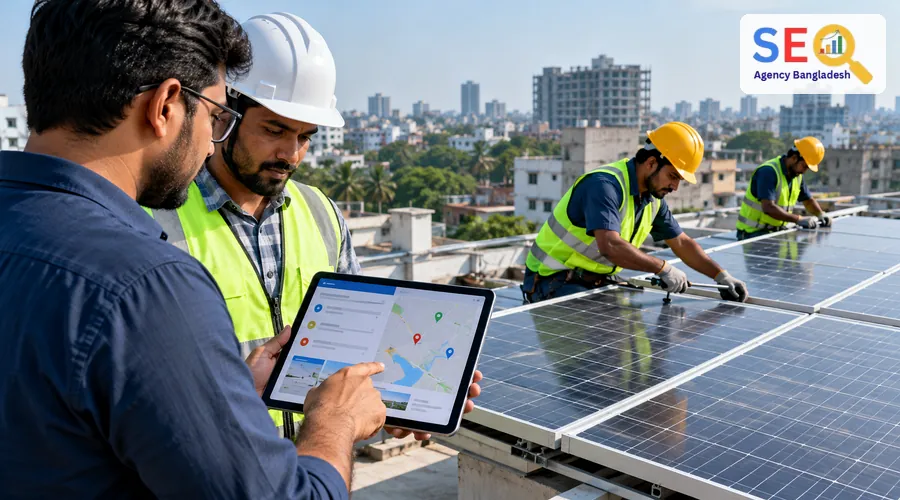
- Publish real project photos. Rooftops, survey work, mounting, inverters, commissioning and finished systems give buyers useful context.
- Ask for honest reviews after completed work. Do not script fake reviews or reward customers for positive ratings.
- Connect the profile to a strong local landing experience. The linked website page should match what the profile promises.
If local search is a major lead source, the Local SEO service is the relevant commercial resource. This guide should remain focused on how a solar business can apply the principles.
Publish content that reduces uncertainty before the quote
Solar buyers often need education before they are ready to talk. That is an advantage for companies willing to publish specific, accurate content. Instead of writing generic “benefits of solar energy” articles, answer questions that occur in a real sales conversation.
High-value topics for a Bangladesh solar content plan
- On-grid, hybrid and off-grid systems: what changes for the buyer?
- What information is needed before a rooftop solar site survey?
- Which roof, load and operating factors affect system sizing?
- How does the net-metering process fit into a rooftop project?
- What is included in an EPC proposal, and what may be excluded?
- What should a factory or commercial buyer compare between proposals?
- How do maintenance, monitoring and warranty responsibilities work?
- What project information should a buyer send before asking for a quotation?
Cost content can perform well, but fixed prices become stale fast. Explain the factors that move the price—system size, panel and inverter choice, mounting, cabling, roof work, batteries, protection equipment, monitoring, design, utility coordination and labour—then date-stamp any real price ranges you publish.
Project pages can do more than a gallery
A useful project page can state the property or sector type, location at a sensible level, project scope, system configuration, installation constraints, process and verified outcome. Only publish capacity, generation, savings or payback figures when the company can support them. Real proof is more persuasive than a row of anonymous logos.
Do the on-page and technical work that makes the content usable
Strong content can still underperform when search engines cannot crawl it cleanly or when users hit slow, confusing pages. Solar sites often become media-heavy because project photos and product images accumulate over time, so image handling matters.
Google recommends using normal HTML image elements, descriptive filenames and useful alt text, and keeping images sharp while optimizing them for speed. That is why the images in this template use real <img> elements, WebP files, explicit dimensions and lazy loading below the hero.
- Write one clear H1 and a concise, descriptive SEO title.
- Match each page title, heading and main copy to one dominant intent.
- Use internal links with descriptive anchor text rather than “click here.”
- Keep important text in HTML, not only inside images or sliders.
- Compress project photos and use stable width/height attributes to reduce layout shift.
- Make core service and project pages reachable through crawlable links.
- Check indexing, canonical tags, redirects and sitemap coverage after major site changes.
A complete SEO audit should diagnose issues before large changes are made, while technical SEO implementation should handle crawlability, indexing, architecture and performance fixes.
Measure qualified solar enquiries, not just ranking screenshots
Rankings are useful diagnostics, but the business goal is better enquiries. Track what happens from the search query to the landing page and then to the sales action. That makes it easier to see whether the problem is visibility, relevance, trust or conversion.
| Metric | Why it matters | Where to review it |
|---|---|---|
| Non-brand impressions and clicks | Shows whether new buyers are discovering the site | Google Search Console |
| Queries by intent | Reveals which topics and services are gaining visibility | Search Console query data |
| Organic landing pages | Shows which pages attract qualified search traffic | Analytics and Search Console |
| Calls, WhatsApp clicks and enquiries | Connects SEO visibility to real sales actions | Analytics and CRM/enquiry records |
| Qualified lead rate | Separates useful demand from irrelevant traffic | Sales follow-up data |
A practical 90-day solar SEO plan
Days 1–30: audit the current site, confirm the commercial page owners, review Search Console, build the keyword-to-URL map, fix obvious indexation and duplicate-intent problems, and clean up the Business Profile.
Days 31–60: improve the core service pages, create missing high-value pages only where there is a genuine service gap, publish one or two strong decision-support guides, add internal links, and optimize image assets.
Days 61–90: publish proof-led project content, strengthen local signals, improve pages that earn impressions but weak clicks, review conversion paths, and start outreach or digital PR where the business has something worth citing.
Do not treat 90 days as a ranking guarantee. It is a sensible implementation window for building the foundation, publishing useful assets and collecting enough data to decide what to improve next.
Common solar SEO mistakes to avoid
- Creating a separate page for every synonym of “solar company” or “solar installer.”
- Publishing dozens of city pages with the same copy and no real local value.
- Writing only top-of-funnel “what is solar energy?” content while ignoring buyer questions.
- Showing unverified savings, payback, capacity or project claims.
- Letting product and project images load as huge files with generic filenames.
- Using a Business Profile address that is not a real customer-facing or staffed location.
- Measuring success only by keyword position instead of qualified enquiries.
Frequently asked questions
What keywords should a solar company target in Bangladesh?
Start with terms tied to real services and buyer intent: system type, installation, EPC, rooftop use cases, net metering, maintenance and genuine service areas. Then add informational topics that support those pages. Do not create a new URL for every wording variation.
Should a solar business create SEO pages for every city?
No. Create a location page only when the company genuinely serves that area and can add specific information about coverage, project types, service process or local proof. Thin city pages can create duplication and a poor user experience.
Does Google Business Profile matter for a solar installer?
Yes, especially when customers look for nearby installers or companies that can visit a site. Keep the profile accurate, use a real location or correct service-area setup, show real project photos and maintain honest review activity.
How long does solar SEO take?
There is no fixed timeline. It depends on the site’s current authority, technical health, competition, content quality, service-area difficulty and how quickly improvements are implemented and crawled. Track progress through visibility, qualified traffic and enquiries rather than a promised date.
What should a solar company track from organic search?
Track non-brand search visibility, the queries that bring relevant visitors, landing-page performance, calls, WhatsApp clicks, enquiry submissions and the percentage of leads that are genuinely qualified for the services offered.
Sources and implementation references
- Google Search Central: SEO Starter Guide
- Google Search Central: Image SEO best practices
- Google Business Profile Help: Local ranking guidance
- Google Business Profile Help: Service-area businesses
- Bangladesh Power Division: National Rooftop Solar Programme
- Bangladesh Power Division: Net Metering Guideline – 2025
Need a solar SEO plan built around your real services?
If your solar or renewable-energy business needs a clearer keyword map, stronger local visibility, better service pages or a full SEO audit, SEO Agency BD can review the site and recommend the next priorities without creating duplicate pages that compete with each other.